Journal · Oct 19, 2026
Ring light setup for lingerie photos
For a ring light setup for lingerie photos, place the light at or just above eye level, about two to four feet away, set it near neutral white, around 5000 K, and lower the brightness until fabric texture is visible. Then choose matte, dense fabrics.
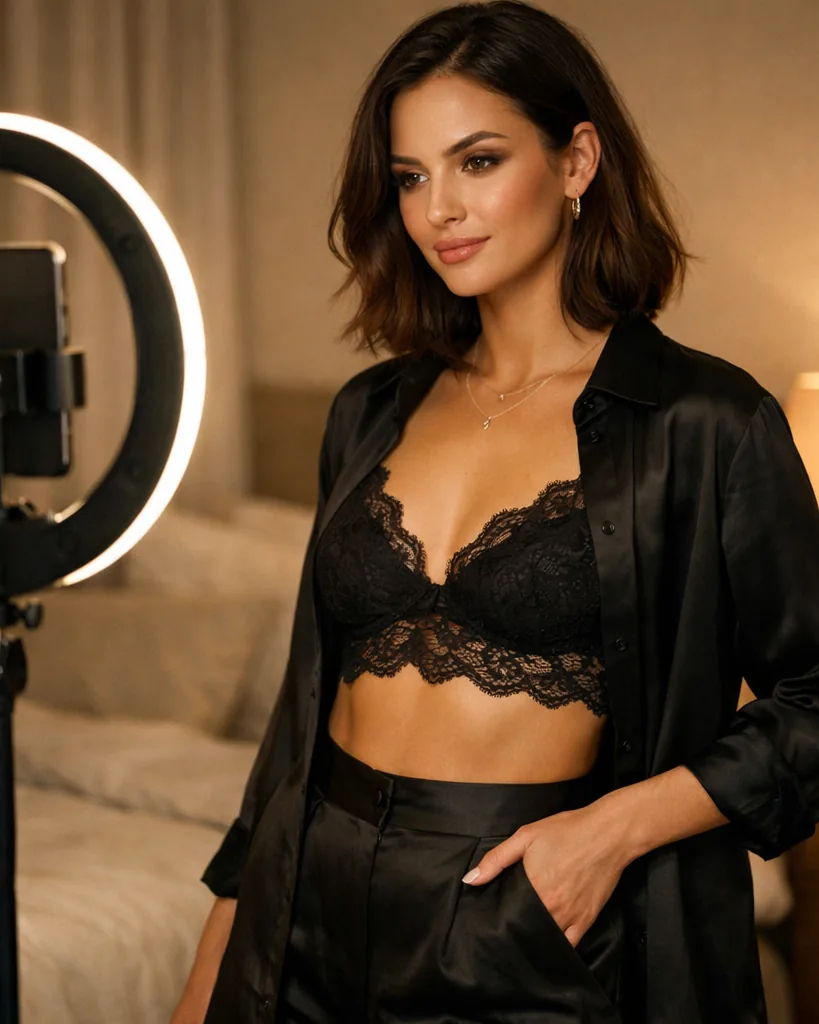
A ring light is the fastest way to get even, flattering light at home. It is also merciless with fabric. The same light that smooths skin flattens thin lace, turns cheap satin into a white sheet and shows every pull in a seam. Getting it right comes down to four things: distance, height, color and the fabric you put in front of it.
Distance from the light
Light falls off quickly with distance, and the closer the ring, the softer and more wrapping it becomes. For lingerie you usually want more than a beauty close up shows.
| Shot | Distance from ring | What you get |
|---|---|---|
| Face and shoulders | 1.5 to 2 feet | Very soft light, catchlight rings in the eyes |
| Waist up | 2.5 to 3.5 feet | Even light on bust and torso, lace detail stays readable |
| Full body, standing | 5 to 7 feet | Harder light, deeper shadows, best with a second lamp |
For full body shots a single 18 inch ring is usually too small. Bring in a second light, even a lamp with a white shade, to lift the legs and the floor so the bottom of the frame does not go dark.
Height and angle
Set the center of the ring at eye level or a few inches above, pointing slightly down. Light from above models the face and the collarbones the way daylight does. Light from below looks theatrical and makes the lower half of the body look heavier.
For a more sculpted look, move the ring 20 to 30 degrees to one side instead of straight on. You lose the perfect ring in the eyes but gain shadows that show the curve of the waist and the shape of a corset. Straight on is flattering for skin, side on is better for shape.
Color temperature
Most rings let you choose between warm, neutral and cool. The number matters less than consistency: mix a warm ceiling bulb with a cool ring and skin turns two colors at once.
- Around 3200 K, warm. Cozy and intimate, good with red, wine and gold. Can make white lace look cream.
- Around 5000 K, neutral. The safest choice. Colors stay true, black stays black.
- Around 6000 K, cool. Crisp, editorial, but can make skin look gray.
Switch off other lights in the room, set the ring, then lock the white balance on your phone if it lets you. That stops the color shifting between frames.
Brightness
Do not run the ring at full power. Turn it down until you can see the pattern in black lace on the screen, then tap to focus on the fabric and lower the exposure one step. Overexposed lingerie loses all detail, and that detail is what makes it look expensive.
Which fabrics glare under a ring light
Smooth, shiny surfaces act like mirrors. Under a direct ring they throw back a bright patch that the phone cannot recover.
- Cheap satin and polyester sheen. Turns into white blotches across the bust.
- Glossy elastic straps. Each strap becomes a hot line.
- Thin, flat lace. Loses its pattern and reads as a gray blur.
If you love satin, move the ring to the side and soften it, or save satin for warm lamp light where its sheen glows instead of glaring.
Which fabrics hold their texture
Dense scalloped lace
Lace with a thick, raised pattern keeps its outline under direct light. That is why the Ring Light Lace Set is cut from dense lace, with a detachable garter belt for a second look.
Fishnet and grid mesh
Open net throws a pattern onto skin that stays visible at any distance. The Fishnet Bodysuit and fishnet thigh highs both read clearly on a small screen. More options on the fishnet bodysuit page.
Strappy elastic
Matte elastic straps draw graphic lines across the body. The Strappy Harness Set has a slider on every strap, so you can move the lines exactly where the light hits.
Vinyl, on purpose
Vinyl is the exception. Its gloss reflects the ring as a bright line along every curve, and that line is the effect. The Vinyl Zip Bodysuit is made for it. Keep the ring slightly to the side so the line follows the body instead of sitting flat in the center.
Background and shadows
A ring light throws your shadow straight behind you. Stand too close to the wall and a hard dark outline appears around your body in every frame. Step at least three feet forward and the shadow drops lower and softer, often out of shot entirely.
The background color changes how lingerie reads. Black pieces disappear against a dark wall, so give them a light or mid tone behind. Pale lace and nude tones look washed out against white, so try a deep curtain or a wood headboard. A plain backdrop beats a busy one under direct light, because the ring makes every object behind you sharper.
Watch your eyes in close ups. A ring light leaves a circular catchlight in each pupil, which many people like. If you prefer a more natural look, move the light slightly to the side so the reflection becomes a small bright point instead of a full ring.
A simple setup to copy
- Ring at eye level, tilted slightly down, three feet away, neutral white, half power.
- Phone in the ring holder, rear camera, timer at three seconds.
- Plain wall behind you, at least three feet back, so your shadow falls low and soft.
- One lamp low to the side to lift the legs.
- Exposure one step down, white balance locked.
The Ring Light Kit brings three looks that stay sharp under a ring, the lace set, the fishnet bodysuit and the harness set, with a shot card of light distances for each. For more pieces chosen for direct light, see harness lingerie.
Questions
How far should a ring light be for lingerie photos?
About 2.5 to 3.5 feet for waist up shots and 5 to 7 feet for full body, with a second lamp to lift the legs.
What color temperature is best for lingerie photos?
Neutral white around 5000 K keeps colors true. Warm light suits red and gold pieces, but turn other lights off so colors do not mix.
Why does my lingerie look shiny under a ring light?
Smooth satin and glossy straps reflect the ring straight back. Move the light to the side, lower its power or choose matte lace and mesh.
What fabric shows texture best under direct light?
Dense scalloped lace, fishnet, grid mesh and matte elastic straps. Vinyl reflects on purpose and works when you want a glossy line.